


How AI-Driven Software Development Is Quietly Reshaping the Future of Business Technology
AI-Driven Software Development: The New Competitive Advantage for Modern Businesses
AI-driven software development is no longer experimental—it is rapidly becoming the default operating model for high-performance technology teams. Across enterprises, startups, and digital-first organizations, AI copilots are now deeply embedded into coding environments, testing pipelines, documentation systems, and debugging workflows.
The result is a fundamental shift in how software is created. Development cycles are shorter. Engineering costs are lower. Product quality is higher. And in many cases, solo developers can now build systems that once required entire teams.
For business leaders, this isn’t just a productivity upgrade—it’s a strategic advantage.
The Rise of the AI Copilot Economy
AI copilots act as real-time engineering partners. They assist developers by:
-
Generating production-ready code
-
Detecting bugs before deployment
-
Writing technical documentation automatically
-
Refactoring legacy systems
-
Suggesting performance and security improvements
-
Automating unit and integration tests
Instead of spending hours on boilerplate tasks, engineers focus on architecture, business logic, and innovation. This has created what many call the “10x developer era,” where small, elite teams outperform much larger departments.
For businesses, this translates into faster product launches, reduced payroll pressure, and dramatically higher ROI on software investment.
From Months to Weeks: How AI Compresses Development Cycles
Traditional development is slowed by repetitive coding, manual testing, and documentation debt. AI removes these bottlenecks.
With AI-driven workflows:
-
Prototypes are built in days instead of weeks
-
Bugs are flagged before reaching QA
-
Documentation is generated alongside code
-
Feature iterations happen continuously
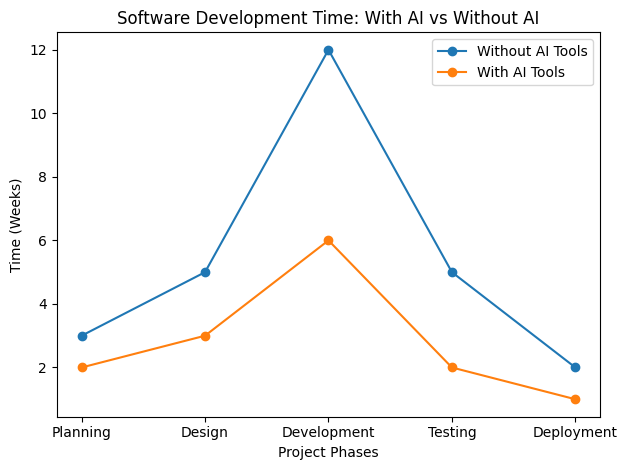
The line graph above illustrates a core business reality: AI reduces development time across every phase of a project. Planning becomes faster with AI-assisted requirements modeling. Development accelerates through real-time code generation. Testing shrinks through automated test creation. Deployment stabilizes with predictive issue detection.
This compression of time directly impacts revenue—faster releases mean earlier market entry, quicker feedback loops, and stronger competitive positioning.
Why AI-Driven Development Matters to Executives
AI is not just a technical tool; it is a financial lever.
1. Cost Efficiency at Scale
AI copilots reduce the number of engineering hours required per feature. Businesses can maintain leaner teams while delivering more software output.
2. Risk Reduction
AI tools catch vulnerabilities, performance issues, and logical flaws earlier in the lifecycle—reducing post-launch failures and compliance exposure.
3. Innovation Velocity
With routine tasks automated, engineering teams invest more time in customer experience, system intelligence, and revenue-generating features.
4. Talent Optimization
Top developers prefer environments where AI handles repetitive work. This improves retention and maximizes the value of elite technical talent.
Solo Builders, Enterprise Impact
One of the most disruptive outcomes of AI-driven software development is the rise of the solo enterprise builder.
Founders and internal innovators can now design, test, deploy, and scale platforms without massive departments. Internal tools that once required long procurement cycles can be built in-house rapidly. MVPs are validated faster. Entire SaaS products are launched by teams of one to three people.
For enterprises, this enables:
-
Rapid internal automation
-
Faster experimentation
-
Lower dependency on external vendors
-
Decentralized innovation models
The economic implications are profound. Businesses no longer scale technology strictly by hiring—they scale it by augmenting intelligence.
AI in the Full Development Lifecycle
AI now touches every layer of modern software creation:
-
Planning: Requirements analysis, system design, technical forecasting
-
Development: Code generation, refactoring, optimization
-
Testing: Automated test suites, regression detection
-
Documentation: API references, onboarding guides, compliance records
-
Maintenance: Predictive debugging, dependency management, performance tuning
This creates a continuous development loop where software evolves faster, breaks less often, and adapts more intelligently to business needs.
Security, Compliance, and the Enterprise Imperative
Modern AI copilots are increasingly trained on secure coding patterns, regulatory standards, and enterprise architectures. They assist in:
-
Identifying insecure dependencies
-
Enforcing code quality standards
-
Supporting compliance documentation
-
Reducing human error in sensitive systems
For regulated industries—finance, healthcare, infrastructure—AI-driven development enhances not only speed, but also governance and accountability.
The Future: AI-Native Businesses
The next generation of market leaders will not merely “use AI.” They will be built around it.
AI-native organizations design workflows assuming automation, intelligence, and real-time optimization at every level. Their software development pipelines become living systems—continuously improving, self-testing, and rapidly deployable.
In this environment, competitive advantage no longer belongs to the largest teams—but to the smartest systems.
Business Takeaway
AI-driven software development is redefining how companies innovate. Those who integrate AI deeply into engineering today will outpace competitors in speed, cost efficiency, and digital capability tomorrow.
For businesses serious about growth, modernization, and market leadership, AI is no longer optional. It is foundational.
❓ Frequently Asked Questions (FAQ)
What is AI-driven software development?
AI-driven software development uses artificial intelligence tools to assist in coding, testing, documentation, debugging, and system design, dramatically increasing speed and efficiency.
How do AI copilots improve productivity?
They automate repetitive coding tasks, generate solutions in real time, detect errors early, and support developers with continuous optimization suggestions.
Can AI replace software engineers?
No. AI amplifies engineers’ capabilities. It reduces routine workload while increasing the importance of architecture, strategy, creativity, and business logic.
Is AI-driven development secure for enterprises?
When properly implemented, AI tools enhance security by identifying vulnerabilities, enforcing coding standards, and reducing human error.
What business outcomes does AI development impact most?
Time-to-market, development cost, product quality, innovation velocity, and scalability.


