



Free climbing a wood utility pole — trusting body position and a leather belt alone to stay upright — used to be a rite of passage in the line trade. It no longer is. A combination of a tightened OSHA PPE fit requirement, a maturing family of Wood Pole Fall Restriction Devices (WPFRDs), and material upgrades in leg gear has pushed the industry toward a single operating model: continuous, mechanically locked fall restriction from the moment a lineman’s boots leave the ground.
Key Takeaways
- OSHA requires continuous fall protection for any climb or elevated position change above 4 feet, enforced under 29 CFR 1910.269.
- A December 2024 amendment to 29 CFR 1926.95, effective January 13, 2025, explicitly requires that PPE — including fall-arrest harnesses and climbing belts — properly fit each individual worker, opening employers to direct citation for ill-fitting gear.
- Standard body belts can no longer serve as fall-arrest devices; WPFRDs such as the Buckingham SuperSqueeze/BuckSqueeze and DBI-SALA Cynch-Lok are now mandatory, locking onto the pole instantly if a gaff cuts out.
- Titanium and aluminum-alloy shanks have replaced steel leg irons in most kits, cutting per-leg weight by as much as 40% without sacrificing tensile strength.
- Correct technique still rests on body mechanics — climbing “on the quarters,” hips back, knees a fist’s-width off the pole — because no WPFRD compensates for poor gaff angle or body position.
The Regulatory Backbone: OSHA, ANSI, and ASTM
Three layers of authority govern what a lineman straps on before a climb, and each does a distinct job.
OSHA sets the legal floor. 29 CFR 1910.269 governs electric power generation, transmission, and distribution work, dictating daily equipment inspection, minimum approach distances from energized conductors, and the mandate for 100% fall protection at height. Deviation carries direct federal citation exposure for utility employers and contractors — this is not treated as a discretionary best practice.
Layered on top of that is the newer fit requirement. OSHA finalized a revision to 29 CFR 1926.95(c) in December 2024, and it took effect January 13, 2025. The updated language requires that all PPE — the standard’s examples include harnesses, coveralls, footwear, and full-body suits — be “selected to ensure that it properly fits each affected employee.” The change brings construction PPE rules in line with language OSHA had already applied to general industry and shipyards, and it has pushed climbing-gear manufacturers toward more modular, adjustable sizing rather than one-size-fits-most kits.
ANSI and ASTM govern the hardware itself. The ANSI/ASSP Z359 family sets the performance and testing benchmark for fall-protection and fall-arrest equipment, including exactly how much dynamic force a WPFRD or harness must absorb during a cutout event. ASTM International, separately, governs the raw materials — the metallurgy behind titanium and aluminum shanks, the tensile strength of belt webbing, and hardness testing for gaff spikes.
Labor and apprenticeship programs govern execution. The IBEW, working with NECA, keeps safety standards collectively bargained and enforced on job sites, while JATC programs — including the Northwest Line JATC and ALBAT — run the hundreds of supervised training hours apprentices complete on wood-pole mechanics and rescue drills before they ever work near an energized conductor.
WPFRDs: The End of the Body Belt
The core equipment shift is the retirement of the traditional body belt as a fall-arrest device. In its place, WPFRDs pair an outer strap that wraps the pole with an inner trailing rope or web grab engineered to bite and lock onto the wood the instant a cutout occurs — meaning the gaff slips but the system catches the fall before the climber drops any meaningful distance. Buckingham’s SuperSqueeze and BuckSqueeze, along with DBI-SALA’s Cynch-Lok, are the systems most commonly specified.
Because these systems are proprietary in their friction adjustment and length-positioning, the manufacturer’s technical spec effectively dictates a lineman’s climbing cadence — the timing of the upward flick that resets the device with each stride, and the spacing needed to maintain grip across varying pole diameters.
Material Science: Lighter Legs, Same Strength
User fatigue is the leading driver of technique breakdown on long climbs, and gear manufacturers have targeted it directly. Traditional steel leg irons have given way to titanium (Buckingham’s BuckLite Titanium) and high-grade aluminum alloys (BuckAlloy, Bashlin Aluminum), cutting the weight carried on each leg by up to 40% while holding tensile strength to ASTM specification. Gaffs — the spikes that penetrate the wood — are factory-set to roughly a 16-degree angle to balance penetration against the risk of the spike wedging permanently in the grain. Secondary lanyards used to transition around crossarms and telephone strands now favor braided technora or neoprene-impregnated nylon over older rope constructions.
Technique: Climbing on the Quarters
Mechanical fall restriction reduces the consequence of a mistake; it does not replace correct body mechanics, which remain built around leverage rather than upper-body strength.
A pole is conceptually divided into four quadrants, and linemen ascend and descend on the “quarters” — roughly a 45-degree angle relative to the crossarm — which gives the best sightline to overhead conductors and the optimal grain angle for gaff penetration.
Center-of-mass control follows what’s informally called the “ass out, chest in” posture: hips pushed back into the body belt to keep continuous tension on the safety strap, knees held roughly a fist’s distance from the pole. Bringing the knees or chest in too close changes the gaff’s angle of entry and can cause it to slide out of the wood — a “gaffing out” event. Arms and hands are used strictly for balance and to flip the fall-restriction strap upward with each step; legs do all of the lifting.
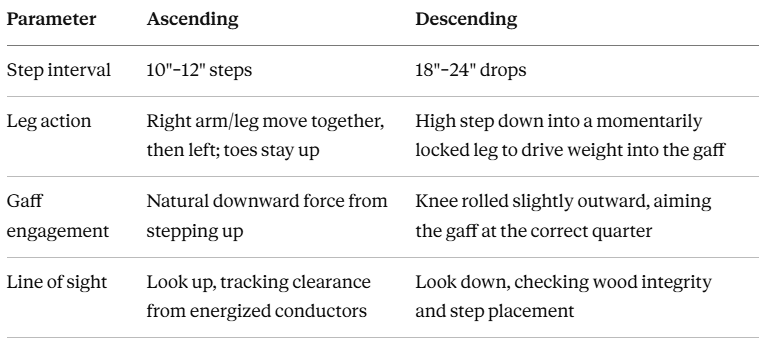
Ascending and descending are mechanically distinct rather than mirror images of each other:
Dropped-Object Control
Because fall-restriction technique requires the hands to stay free for balance and WPFRD management, tool control at height is handled separately, under ANSI/ISEA 121-2018. Hand tools used aloft — wrenches, skinning knives, skinning hammers — must be attached to the harness or tool belt with certified locking lanyards, removing the risk of a dropped tool striking ground crews or damaging equipment below.
7. FAQ
Is free climbing wood poles still legal under OSHA? No. OSHA’s 29 CFR 1910.269 mandates continuous fall protection for climbing or changing location above 4 feet, and a traditional body belt alone no longer satisfies that requirement.
What changed with OSHA’s 2025 PPE rule? An amendment to 29 CFR 1926.95(c), effective January 13, 2025, added explicit language requiring that PPE — including climbing harnesses — properly fit each individual worker, exposing employers to citation for ill-fitting gear.
What is a WPFRD? A Wood Pole Fall Restriction Device is a system, such as the Buckingham SuperSqueeze or DBI-SALA Cynch-Lok, that combines a pole-wrapping strap with a rope or web grab that locks onto the wood instantly if a gaff cuts out.
Why did leg irons switch from steel to titanium or aluminum? Lighter shank materials reduce per-leg weight by up to 40%, cutting the fatigue that manufacturers and trainers cite as the leading cause of technique breakdown on long climbs.
What does “climbing on the quarters” mean? It refers to ascending and descending a pole at roughly a 45-degree angle relative to the crossarm, which optimizes both sightlines to conductors and gaff penetration into the wood grain.
8. Closing Analysis
What remains unsettled is less about the hardware than about enforcement consistency: OSHA’s fit-rule language leaves “properly fits” without a hard technical definition, which industry commenters have flagged as a compliance gray area for employers sourcing gear across a wide range of worker body types. Watch for clearer guidance or interpretive letters from OSHA on what constitutes demonstrable fit, and for continued rollout of modular WPFRD sizing from manufacturers responding to that ambiguity. The broader trajectory is settled, though: fall restriction is now the operating baseline for wood-pole work, and technique, apprenticeship curricula, and equipment design are converging around it.


